When Does a Housing Crisis Become a Housing Emergency?

The everyday inconsistencies of everything.

When wildfire forces someone from their home, the question is:
Where can we put them?
When someone is already homeless, too often the question becomes:
How do we get them out of here?
Over the past few days, I’ve been watching the wildfire coverage from here in the Okanagan.
Homes have burned. More than 20,000 people have been forced to evacuate. Seniors have been displaced. Farmers have scrambled to care for animals. People have left with little more than what they were wearing.
And people have stepped up.
They should.
This isn’t a complaint about wildfire evacuees receiving too much assistance. It isn’t an argument that somebody whose house burned should receive fewer meals, fewer nights in a hotel or less compassion.
Quite the opposite.
I’m watching what happens when we collectively agree that having nowhere safe to live is an emergency.
And I’m wondering why we don’t always agree.
A State of Emergency

On August 8, British Columbia declared a provincial state of emergency as wildfires burned across the province and mass evacuations took place in the Okanagan.
More than 20,000 people were forced to evacuate.
By August 11, the province had secured approximately 1,600 hotel rooms and 1,000 group-lodging spaces for displaced residents.
Government, municipalities, emergency workers, businesses, charities, volunteers and ordinary residents mobilized.
Good.
This is what we’re supposed to do when people are displaced.
But Kelowna already had displaced people before the first evacuation order was issued.
Kelowna’s 2025 Point-in-Time Enumeration counted at least 806 people experiencing homelessness on a single night, including 224 who were unsheltered.
A Point-in-Time count is a snapshot and a minimum. It doesn’t count everybody who experiences homelessness over a month or a year, and people can be missed.
I’m also not pretending that 806 people experiencing homelessness and more than 20,000 wildfire evacuees are equivalent populations.
They aren’t.
But that’s precisely what bothers me.
The smaller number has been with us much longer.
One produces extraordinary emergency mobilization.
The other risks becoming part of the landscape.
Waiting With Hope and Help

That headline stopped me.
Not because there was anything wrong with it.
Because there was something right about it.
Waiting with hope and help.
One evacuee waiting outside the Penticton Community Centre put his situation simply:
“Just waiting for the okay to go back.”
Think about the assumptions contained in that sentence.
An evacuee is understood to have been displaced from somewhere.
There was a before.
There is an awful and uncertain now.
And everybody assumes there should eventually be an after.
Return.
Rebuild.
Recover.
We don’t look at a wildfire evacuee sleeping somewhere temporary and conclude that this is simply where that person belongs now.
We expect their displacement to end.
We expect a wildfire evacuee’s homelessness to end.
We’ve learned to tolerate everyone else’s.
And look at those four words again:
Waiting with hope and help.
Imagine them above a homelessness story.
Not:
Encampment concerns.
Public safety.
Trespassing.
People moved along.
Instead:
HOMELESS IN KELOWNA: WAITING WITH HOPE AND HELP
It sounds different.
Why?
Maybe part of it is simply the nature of disaster reporting. Wildfire displacement happens suddenly, visibly and collectively.
Maybe homelessness accumulates slowly enough that we’ve become accustomed to seeing it.
And maybe part of it is the noun.
What Happens When We Change the Noun?
Instead of saying I am homeless, suppose I said:
I am a housing-crisis evacuee.
I’ve been displaced from permanent housing. I’m staying in emergency accommodation while trying to secure somewhere permanent to live.
Nothing about my material circumstances changed.
Only the words did.
But doesn’t it sound different?
Evacuee suggests that something happened to somebody.
Someone was displaced.
They need temporary assistance.
Eventually, they’re supposed to go somewhere else.
Preferably home.
Homeless can swallow the story that came before it.
The lost apartment.
The disability.
The unaffordable rent.
The relationship breakdown.
The job loss.
The addiction.
The trauma.
The mistake.
The illness.
Sometimes several of those things at once.
And instead of asking where someone can go, we can start asking:
Does he use drugs?
Why doesn’t he work?
Did he spend his money irresponsibly?
Did he refuse housing?
Why is he sitting there?
Why is he sleeping there?
Why doesn’t he go somewhere else?
The person displaced by wildfire is someone we need to accommodate.
The person displaced by the housing crisis can become someone we need to move along.
What if we described an encampment as:
A group of people displaced by the housing crisis.
Would we see the people differently?
I don’t know.
But it’s worth asking.
“I’m in the system, but I’m not in the system.”
Then wildfire evacuees started running into bureaucracy.
And suddenly some of the coverage sounded remarkably familiar.
There were reports of long waits for Emergency Support Services, identification difficulties and people struggling to navigate assistance while displaced.
One evacuee described the frustration this way:
“I’m in the system, but I’m not in the system.”
I don’t feel sorry for these people.
I feel empathy for them.
There’s a difference.
I recognize something in navigating government systems while your life doesn’t fit neatly into their boxes.
And that’s when some of this started sounding suspiciously like the Ministry of Social Development and Poverty Reduction.
Except it wasn’t.
It was Emergency Support Services.
An emergency system struggling under enormous sudden demand isn’t surprising.
What interests me is the assumption about what should happen next:
Fix the barriers between displaced people and the assistance they need.
I’d like to see that assumption applied more consistently to poverty.
The B.C. Ombudsperson reported this January that serious telephone-access problems in the income and disability assistance system persisted eight years after its original systemic investigation.
Between 2022 and 2024, only about 13 per cent of calls were answered within 10 minutes, despite a government service standard of 80 per cent.
Those callers are trying to access income assistance, disability assistance and essential services.
Their emergency may not produce flames visible from kilometres away.
That doesn’t necessarily make the consequences less real.
What Does an Emergency Cost?
There’s another uncomfortable comparison.
Money.
For a single adult receiving regular B.C. income assistance, the basic monthly support allowance is $560, separate from shelter assistance.
That’s roughly $18.40 a day when expressed as a daily equivalent.
For a single person receiving disability assistance, the support allowance is $983.50 per month, again separate from shelter.
That’s roughly $32.35 a day.
Those aren’t daily payments. They’re monthly benefits converted to daily equivalents so we can see the scale.
Now compare them with Emergency Support Services.
Current B.C. ESS rates allow up to $53 per person per day for restaurant meals, or $22.50 per person per day for groceries.
ESS and income assistance aren’t equivalent programs.
ESS is temporary emergency assistance. Income and disability assistance are ongoing programs expected to cover a much broader range of expenses.
But the difference still raises an interesting question.
Ordinary income assistance:
About $18.40 per day in non-shelter support.
PWD:
About $32.35 per day in non-shelter support.
ESS:
Up to $53 per day just for restaurant meals.
And under B.C.’s income and disability assistance rules, a food crisis supplement can provide up to $50 per person in a calendar month.
ESS can authorize up to $53 for restaurant meals in one day.
Different programs.
Different purposes.
Different ministries.
Same provincial government.
I’m not arguing that $53 is too much.
I’m asking:
What does the government believe it costs to meet somebody’s basic needs when it recognizes their circumstances as an emergency?
Maybe the answer isn’t that evacuees should receive less.
Maybe it’s that poverty deserves more.
The Same Smoke
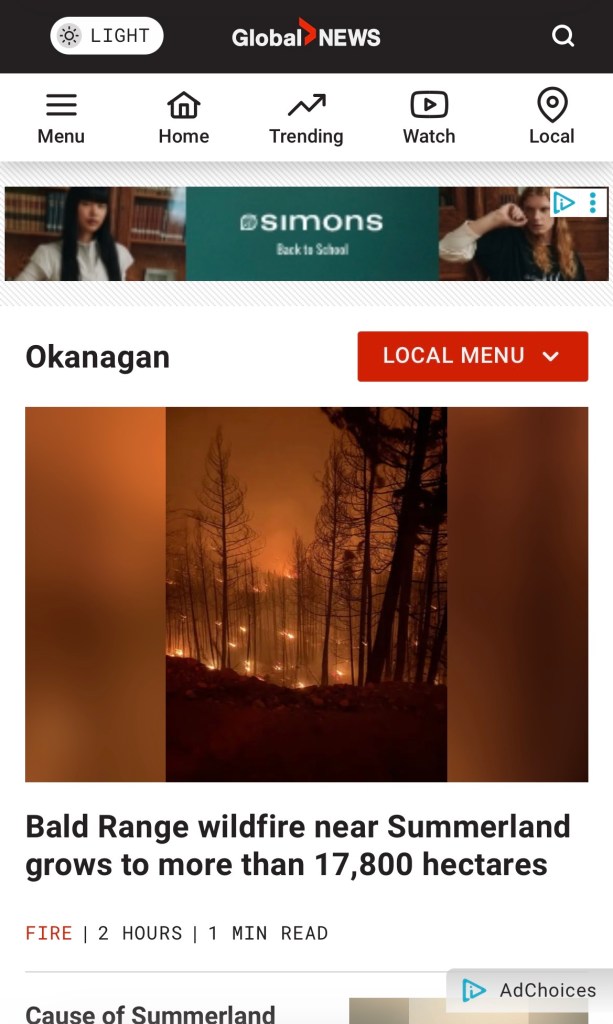
There’s another population in this wildfire story.
People who were homeless before the fire started.
They’re breathing the same smoke.
Except they may not have a house where they can close the windows.
They may not have air conditioning or filtration.
They may not have somewhere clean to shower and change their clothes.
They may have medications and belongings that have to travel everywhere with them.
They may spend their days moving between public places where they’re permitted to remain temporarily.
The wildfire didn’t create their housing emergency.
It landed on top of it.
If someone sleeping rough is inside an evacuation area, they’re obviously affected by the evacuation.
But what about somebody sleeping rough elsewhere in the smoke?
Where exactly are they supposed to evacuate to?
Get out of the smoke.
Get indoors.
Don’t loiter here.
Where?
They Did It to Themselves
Eventually somebody will say the comparison is unfair.
Wildfire evacuees didn’t choose this.
Homeless people made choices that put them there.
I’ve heard variations of that argument plenty of times.
So let’s follow its logic.
People make financial decisions that end badly.
People remain in relationships that collapse.
People make decisions about where to live despite environmental risks.
People smoke and later require cancer treatment.
People ski and break their legs.
We understand something important in all of those situations:
Participating in the causal chain is not the same thing as choosing the outcome.
We generally don’t say:
Well, you participated in the causal chain, therefore your immediate human needs no longer deserve a response.
I’m not suggesting people who lost homes to wildfire somehow brought it upon themselves.
They didn’t mean to lose their homes any more than most people experiencing homelessness intended to lose theirs.
That’s the point.
Imagine applying the moral audit we sometimes apply to homelessness to somebody standing outside the remains of a burned house.
Did you know you lived in an area with wildfire risk?
Did you prepare adequately?
Should you have moved?
Could you have made different decisions?
What an absolutely shitty thing to ask somebody who has just lost their home.
Exactly.
We don’t conduct a moral audit before deciding whether a wildfire evacuee deserves dinner.
We recognize the immediate human need first.
So why does homelessness so often trigger the audit?
Did they use drugs?
Did they waste their money?
Did they lose their job?
Did they refuse help?
Did they burn bridges?
Those questions can sometimes matter when we’re trying to understand how someone became homeless and what might help them become permanently housed.
They’re very different from:
Does this human being need food, clothing and somewhere safe to sleep tonight?
We Were Warned About Both
Wildfire risk didn’t sneak up on us.
Neither did the housing crisis.
For years, we’ve been warned about the conditions contributing to increasingly destructive wildfire seasons.
And for years, we’ve been warned about housing affordability and homelessness.
We’ve had reports.
Strategies.
Counts.
Consultations.
Programs.
Committees.
Announcements.
More reports.
We were warned that the climate was changing.
We were warned that people needed housing.
When wildfire arrives, we have evacuation orders, reception centres, emergency accommodation, meal assistance, transportation, emergency communications and eventually recovery.
We call it:
An emergency.
When people lose housing one apartment, one job, one disability, one relationship, one unaffordable rent or one bad decision at a time, we call the accumulated result:
A crisis.
So I’ve started wondering:
How many years does a crisis have to continue before we start treating it like an emergency?
806
Kelowna’s latest Point-in-Time enumeration counted at least 806 people experiencing homelessness.
Among them were 224 people counted as unsheltered and 308 in emergency shelters.
Participating emergency shelters had capacity for roughly 321 people on the night of the count.
Again, these are snapshot figures, not the number of different people who experience homelessness over an entire year.
And they’re not directly comparable with more than 20,000 people evacuating almost simultaneously.
But consider what we’ve just demonstrated.
In response to the wildfire emergency, approximately 1,600 hotel rooms and 1,000 group-lodging spaces were secured for displaced residents.
I’m not suggesting we permanently house Kelowna’s homeless population in hotel rooms.
Hotels aren’t homes. Emergency accommodation isn’t permanent housing. Some people need supportive housing and services beyond a room.
I’m talking about capacity.
When a situation is understood as sufficiently urgent, enormous logistical barriers become problems to solve.
We find buildings.
We find beds.
We find food.
We find transportation.
We increase staffing.
We change procedures.
We ask businesses for help.
We ask communities for help.
We ask ordinary people for help.
Nobody looks at an overwhelmed evacuation centre and concludes:
Well, maybe there are simply too many evacuees.
We look at the line and say:
We need more capacity.
That’s the part I can’t stop thinking about.
Only the Clothes on Their Backs
Wildfire coverage has described people escaping with little more than what they could carry.
People responded exactly as they should.
Clothes.
Food.
Accommodation.
Community support.
But only the clothes on their back could describe plenty of people arriving at an emergency shelter.
The physical need can look remarkably similar.
What changes is the story we attach to it.
If it’s an evacuee:
We need to find this person somewhere to stay.
If it’s somebody homeless:
They can’t stay here.
That’s an inconsistency worth examining.
The Emergency We Recognize

Look at a news homepage during a major wildfire.
Fire growth.
Smoke.
Evacuations.
Highway closures.
Flights.
Health services.
Emergency declarations.
Return dates.
Accommodation.
Recovery.
The community becomes organized around the consequences of displacement.
That’s appropriate.
A wildfire really is an emergency.
None of this diminishes the terror of watching flames approach your home, fleeing without knowing what you’ll return to, or discovering there’s nothing left to return to.
I don’t need to diminish somebody else’s loss to talk about mine.
Watching this response has actually made something clearer to me.
I don’t feel sorry for wildfire evacuees.
I feel empathy for them.
Pity looks down.
Empathy recognizes something.
I know something about uncertainty.
I know something about temporary accommodation.
I know something about having your belongings with you because you don’t have another secure place for them.
I know something about government systems deciding what assistance you’re entitled to.
Our circumstances aren’t identical.
They don’t have to be.
Shared humanity doesn’t require identical biographies.
We’re Here for Each Other
That’s what I find genuinely hopeful about the wildfire response.
People find clothes.
They prepare accommodation.
They care for animals.
They volunteer.
They donate.
They make room.
Governments move resources.
Communities improvise.
People see another human being who has suddenly lost somewhere to live and understand:
They need somewhere safe to exist.
I don’t resent any of it.
I want more of it.
I want us to remember that capacity for compassion after the evacuation orders are lifted.
Because we’ve demonstrated something important.
We are capable of looking at somebody who has nowhere to live and responding first to the immediate human need instead of first determining how much blame they deserve.
We already know how to do this.
Apparently, sometimes we just need smoke in the sky before we remember.
Maybe homelessness doesn’t need a literal provincial state-of-emergency declaration.
A declaration by itself doesn’t create another apartment.
Calling somebody a housing-crisis evacuee doesn’t build housing either.
But language matters because language tells us what deserves urgency.
Crisis can continue for years.
Emergency demands a response.
And evacuee tells us something happened to a person from which we expect them to recover.
Maybe that’s why I keep coming back to the word.
Because whether someone fled a wildfire yesterday or lost their housing months ago, there comes a moment when the immediate question is remarkably similar:
Where can this person safely exist tonight?
For one group, we mobilize.
For another, sometimes we put up a sign.
NO LOITERING.
The everyday inconsistencies of everything.

Personal Dispatches is an independent documentary journalism project exploring housing, homelessness, accessibility, poverty, public policy, and everyday life in Kelowna through lived experience. If this story made you see something differently, I hope you’ll read another, share this one, or simply start a conversation. Sometimes that’s where change begins.
Support Personal Dispatches
If you found this story meaningful, you can learn more about supporting the project here: